
The following blog explains my decision to undergo a stem-cell transplant (HSCT for MS) in Puebla, Mexico, in January 2024 and my experience to date.
Read more: HSCT for MSChapter 1 of 6: My MS Got Bad
Quick recap of my MS life: I was diagnosed with MS in January 2003, and my MS was fairly gentle for the next 20 years. I attribute much of my good fortune to my strict adherence to the Overcoming MS lifestyle, which I started on Thanksgiving Day 2011. I attribute another good portion of my MS gentleness to pure luck. I took MS drugs directly after diagnosis, as did many people, and their MS was much more aggressive, causing permanent damage and disability within a few years of their diagnoses.
Fast forward to roughly mid-2023, and MS started getting “real” for me. Why then, after 20 good years? As with all things MS-related, there are no clear explanations, but my theory is that it was a confluence of menopause, too many Covid vaccines/boosters, and an unusually stressful work environment.
Life increasingly sucked as my ability to walk deteriorated over a period of roughly six months in a way I had not experienced for the prior 20 years with MS. I had trouble admitting the problem to myself because I had always been able to recover from MS exacerbations by meditating, exercising, vacations, etc.
Starting in roughly August 2023, I tried to avoid any situation that required me to walk in front of others for more than roughly 10 minutes. Crazy! I stopped attending my beloved weight-lifting class at the gym; my muscles were still strong, but my walking was noticeably, temporarily extra wonky after the class. Walking out after class with fellow students could attract the attention of someone who would look at me with concern. I hate “that look.”
I am very energized by social connections, so I initially kept a busy calendar but would arrive before others to restaurants or work meetings so that I only needed to stand to greet people or walk out with the group afterwards. I sat at tables with colleagues or friends until I thought I would die from needing to go to the bathroom because I didn’t want anyone to watch me, walking wonkily from the table to the bathroom or back. As time went on, I delegated work trips to my deputy as professional development for her, but frankly, I was avoiding interactions for fear of someone – a client, heaven forbid – asking what happened to me, or my worst nightmare, reporting to my boss that I was not fit for my job. I often blamed my wonky walking on a bad knee, which was a lie, but an excuse that most people immediately understood and which didn’t generate “that look” or additional questions/concerns/follow-up.
Life was busy, and I couldn’t believe that this problem couldn’t be mitigated by my old trusty practices. By complete accident, I discovered an effective way to ignore my problems. One time when the hot water in an Airbnb stopped working, I took a reeeeeally cold shower out of pure necessity. To my surprise, this “cold exposure” fixed my body for about 40 minutes. After this happy accident, I filled 12 two-liter plastic bottles with tap water at home, and I kept them in my home freezer. Each morning, I filled the bathtub with water and the 12 frozen bottles. During the hour that it took for the bath water to reach the coldest possible temperature — 11C (52F) — I ate breakfast and packed everything needed for my work day. Then, for five and a half minutes, I submerged myself in the ice water up to my shoulders. I emerged with a totally functional body, and I was then “on the clock,” knowing that I had about 40 minutes to be normal.
Normal is so under-rated. For 40 minutes following cold exposure, I walked without thinking about walking. I could look up at the trees, and I didn’t worry about falling. I could walk 10 minutes to my office and spend the balance of my time stopping by colleagues’ offices to wish them a good morning or chat about the day’s challenges ahead, appearing carefree and normal. In that short window of time, I saw the world as a wonderful place and not as a series of dangers and potential humiliations from tripping/falling. But I had a sense of panic, a giant clock ticking as my body slowly returned to its old, wonky MS ways.
Later in my work day, I had just enough energy to walk five minutes from my office to the gym. There, I took another ice-cold shower at the gym, which enabled me to walk and even run a bit on the treadmill…followed by another ice-cold shower to get back to my afternoon at work. I knew this was an unsustainable solution, but cold exposure did allow me to feign normalcy, almost. In between exposures, I would work at my desk, reading email and working like normal desk jockies.
By late 2023, I was taking at least three cold showers or baths each day. More crazy! I didn’t enjoy the cold, but I was addicted to fleeting normalcy. I knew that if I stopped moving, I would have a lot of other health problems.
I literally saw no other options because the MS drugs available were rarely effective for progressive MS. I was angry, confused, and desperate.
Chapter 2 of 6: A Fool To Dream?
Since my 2003 diagnosis of MS, I saw countless news headlines about “ground-breaking” advancements in MS. They were all bullshit for practical purposes. The most recent one at that time was a “quantum leap” in understanding that the MS gene was originally a feature that protected shepherds from diseases of their flocks.
Then I heard a podcast produced by OMS with Dr. Richard Burt of Northwestern University about autologous HSCT (aHSCT): a stem cell transplant that uses your own stem cells taken from your bone marrow to re-boot your immune system. I remember thinking how logical HSCT sounded. I had grown accustomed to hearing of potentially very exciting protocols for treating MS that were in the early stages of research and trial and would not be available for a decade or longer, but HSCT had been done for leukemia and MS for decades by the time I heard the podcast. Why had no doctors ever mentioned HSCT to me as a possibility? More craziness. It all looked very real, but very expensive – over $100,000 in the UK and over $250,000 in the US, after you meet strict qualifications. Clinica Ruiz in Mexico offered HSCT for MS for $57,500. Insurance coverage? I was skeptical.
At age 52, I didn’t look further at HSCT in the relatively cheaper UK, which I heard would not perform HSCT on anyone older than 50. On a whim, I logged onto the website of Clinica Ruiz in Mexico and completed a two-minute HSCT application. Two days later, Clinica Ruiz told me that I was accepted for HSCT. Ha! I immediately suspected them for being a baaaaad place, giving hope to people like me – old and with advancing MS. I told my husband that I had been accepted, but I put aside the possibility of HSCT because it seemed so unreal, far too easy in the MS world where nothing is easy.
Knowing I was accepted for HSCT in Mexico, and that my job contract was coming to an end in Feb 2024, I knew that I had to act fast if I wanted to investigate health-insurance coverage. Because I was employed by a US company outside the US, my health insurance company – Aetna International – was accustomed to covering healthcare outside the US. Within three days, Aetna approved pre-payment of 90% of the $57,500 for HSCT at Clinica Ruiz.
Even the most expensive HSCT on the market is cheaper than life-long MS drugs that cost 10s of thousands of dollars per month in the U.S. The economics of HSCT are undeniably pro-HSCT. Still, insurance companies have historically denied HSCT for MS. In my HSCT group of 19 in January 2024, I was the only person to have insurance coverage. On social media and in my group, there are lots of stories of people doing GoFundMe campaigns, dipping into retirement savings, or selling their homes to afford HSCT. The non-profit HSCT Hope – started by a Chicago lawyer who got a second chance at life thanks to HSCT for MS – started this organization to support people looking for fundraising options/ideas and insurance/medical travel applications and appeals.However, as time goes on, I increasingly hear stories of people’s insurance covering it, too.
Chapter 3 of 6: ¡Viva México!
For nights after Aetna International approved HSCT payment, I couldn’t sleep. I felt at times like a child on Christmas morning, so excited about this possibility. At other times, I was terrified, lost in life logistics of my husband leading the effort by buying air tickets to Mexico, packing, etc. Then I read Everyday Miracles by Dr. Richard Burt, with a foreword by the XIV Dalai Lama, and I never looked back.
After reading this great book, I still had moments of terror, but I felt confident that HSCT was a solid plan to halt progression of my recently aggressive MS. I recalled waves of a similar feeling of fear when I was a child at our public swimming pool. The pool’s rule was that if you started to go up the ladder of the “high dive” diving board, you could not change your mind and descend the ladder. You had to complete your ascent and jump off the terrifyingly high board. The HSCT process was well underway: no going back.
In a nutshell, the 28-day HSCT process in Mexico was among my greatest experiences of my adult life. My husband joined me as my “caregiver,” as required by Clinica Ruiz. From the moment we arrived, the staff at the Center for Outpatient Services (COR) built our confidence, which only grew stronger over the month. They gave us a cell phone that provided precise details for each day’s agenda, as well as pre-programmed texting so that we could ask questions directly to the doctors and nurses, participate remotely in meetings with fellow HSCT patients and caregivers during which the medical team prepared us for each phase of HSCT throughout the month, and connect with my 19 fellow patients and caregivers from the Netherlands, France, Germany, Austria, Sweden, the US, and Canada. Doctors, nurses, and logistics and restaurant staff responded to all questions at all hours of the day or night. Personally, my husband and I never felt more well cared for.
Life at Clinica Ruiz’s residency in Puebla was strangely wonderful. It has a gym for caregivers and patients. Its rooftop deck has an amazing view of one of Puebla’s many volcanoes; nearly each day (except for a few during a phase called neutropenia, following COR health protocols), we spent time on the rooftop with members of our group of 19 fellow patients and their caregivers. The food served three times per day (plus snacks) to me and my husband was tailored to my preferences (as defined by Overcoming MS); others’ dietary preferences were also catered to; the COR restaurant and admin staff were fun and kind for the duration of our stay.
HSCT is a serious medical procedure with chemotherapy etc, but I never felt overwhelmed or in danger because the whole process was so exquisitely managed by HSCT Mexico / Clinica Ruiz. Some of my fellow patients had a rough time with bone pain that they compared to the pain of natural child birth, and nausea, but the medical team was always available to get them through it. I had no bone pain and verrrrry minimal nausea, which was inexplicable but welcome. HSCT for MS does have a history of deaths; however, at the time of this blog, the mortality rate for HSCT for MS is 0.26%, which is lower than hip-replacement surgery.
The most challenging part of HSCT for me was psychology of losing my hair. I chose to buzz-cut my should-length hair before the chemotherapy caused it to fall out in approximately the end of the third week of the four-week process. I have never liked my hair, so I surprised myself by my fear of this moment. In fact, I discovered that I feared losing my hair more than I feared chemotherapy. Surrounded by 19 fellow patients and their caregivers, I felt a camaraderie that helped me dive into the experience and embrace my hair loss as a small price to pay for a chance at halting my MS.
Both my husband and I were really sad to depart Clinica Ruiz.
Chapter 4 of 6: The HSCT Rollercoaster
As I type, I am day +83 following my stem cell birthday on January 24, 2024, when Clinica Ruiz re-injected my stem cells back into my body. Only 10% of HSCT patients experience improvements in symptoms immediately following the procedure. I have felt no distinct improvements yet, so I am not one of those 10%. With the others who are not part of the 10%, I can only wait and see if HSCT halts my MS. The plan is to get an MRI 12 months after HSCT to see if it shows any MS activity. The HSCT rollercoaster – worsening and improvement of symptoms, hope, worry that you are relapsing or a non-responder – can continue for more than a year.
The suspense and isolation of this rollercoaster can be difficult, except for the thousands of HSCT “alumni” around the globe, more than 1,600 of whom got HSCT in Mexico. These alumni are an extraordinarily generous group of people whom I interact with on Facebook* or via the HSCT Warriors podcast. They remind me that my body took years of MS abuse, so it will take time (years) for me to heal, if I am among the people for whom HSCT halts MS. Fingers and toes are crossed.
My baseline during my first 20 years with MS was an EDSS of 0.5 to 1.5. I even ran two marathons. In the year before I discovered HSCT, my symptoms worsened quickly. Clinica Ruiz conducted many tests (blood, heart, lungs, etc etc) just prior to HSCT and my MS was “replapsing-remitting” and a 3-3.5 on the EDSS scale of 10 (10 being worst).
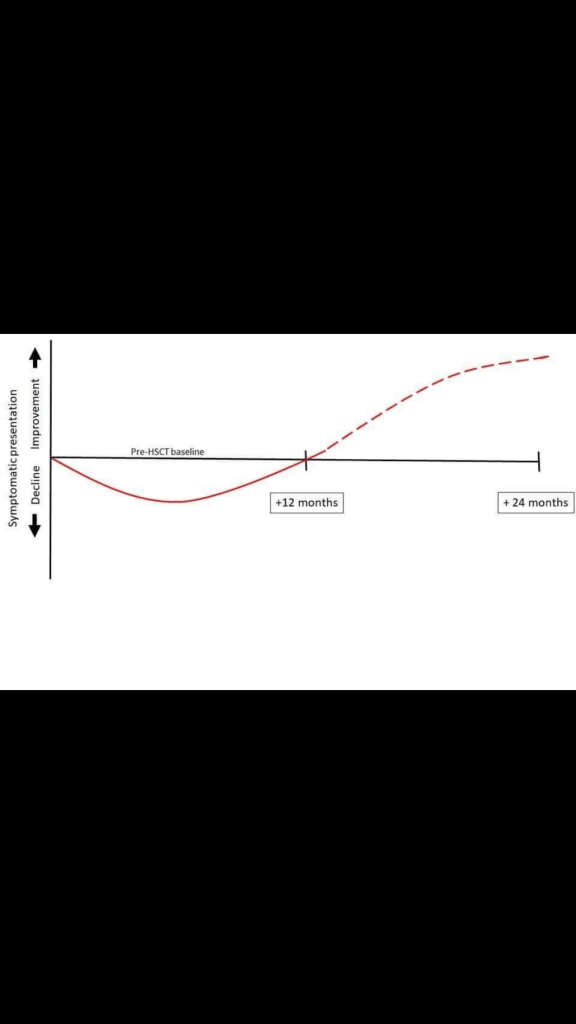
In fact, many people experience a worsening of their symptoms after HSCT during the first year (and even well into their second year) before reaching their pre-HSCT baseline. From there, people’s EDSS scores may or may not improve. I have spoken with several people whose EDSS scores went from 4.5 to 0.5 or similar improvements thanks to HSCT and after more than a decade with MS disability before HSCT.
Actress Selma Blair recorded her HSCT experience at Northwestern University in the movie Introducing Selma Blair, which shows a *much* rougher HSCT procedure than I experienced at Clinica Ruiz, but the movie does not follow her beyond year 1 post-HSCT. The movie implies a level of frustration with her outcome; but her performance in Dancing With The Stars is, in my opinion, miraculous, regardless of her decision to not proceed beyond episode 4.
Many HSCT alumni have public blogs to track their progress during and after HSCT. It is not uncommon for alumni to feel certain that HSCT did not work for them, and then to see improvements 1-3 year(s) after HSCT. Here is one example on Facebook – a 3.5-minute video – where a woman believed in year 2 that she was a non-responder, but in year 3 had reached a point where she could consistently run, paddle, stay out late partying, etc. I spoke to this particular woman in her year 7 post-HSCT, and she was still feeling great. These are stories I have heard repeated over and over by HSCT alumni.
The following graph shows the average experience on the HSCT rollercoaster, recognizing that each body’s recovery rollercoaster is as different as their MS symptoms.
To increase the chances that HSCT will halt my MS, I do just a few fairly simple things. I take two medicines (acyclovir and bactrim), which Clinica Ruiz prescribes to protect you from viruses and other bugs while your new immune system rebuilds for six months following the completion of HSCT. During that time, I must avoid large crowds and wear a surgical mask in public. I follow a “neutropenic diet,” which sounds fancy, but basically means that I eat only cooked food; raw fruits and vegetables are prohibited for six months to mitigate risks of food-borne infections, with the exception of avocados and bananas. Why this exception? Frankly, I don’t know. Six months feels long as I type in month 3, but again, it’s a very small price to pay.
Most people go back to work within a month or two of completing HSCT, while following these precautions. I chose to quit my job mostly because I had saved enough to do so, and I was tired of my career; and stress definitely makes my MS worse. Following HSCT, I started exercising according to the MSing Link protocol, which I have found strategic, structured, and informed by great research. I also walk as much as I can each day, instead of sitting behind my computer for 10+ hours per workday, on weekends, vacations, and holidays, as I did for years in my career.
For what it’s worth, I caught Covid only about three weeks after my stem cell birthday, and it wasn’t bad. I was reeeeeally scared, but Clinica Ruiz monitored me closely and remotely via WhatsApp. I would have gone to the hospital if I had any real concerns. I just took Paracetamol 1 g to keep my fever below 101.5 F. As I type, I also have a bad head cold, which I will hope is a “training course” for my new immune system, as we think of young children getting sick. Many HSCT alumni don’t get sick for more than a year after the procedure. I wish I were one of them, but I won’t lose sleep worrying about my new immune system, which for reasons I will never understand, it working nicely.
Chapter 5 of 6: The Data
HSCT does not promise to cure MS, nor to improve your EDSS, but it halts progression in a high percentage of recipients (see below), which is better than any MS drug, all of which only promise to slow progression, cost astronomical amounts monthly, and causes really bad side effects in some people. One HSCT alumni put it this way: MS chains you to train tracks. HSCT has a high percentage of a chance to stop the train; MS drugs say they can slow the train. Which would you choose?
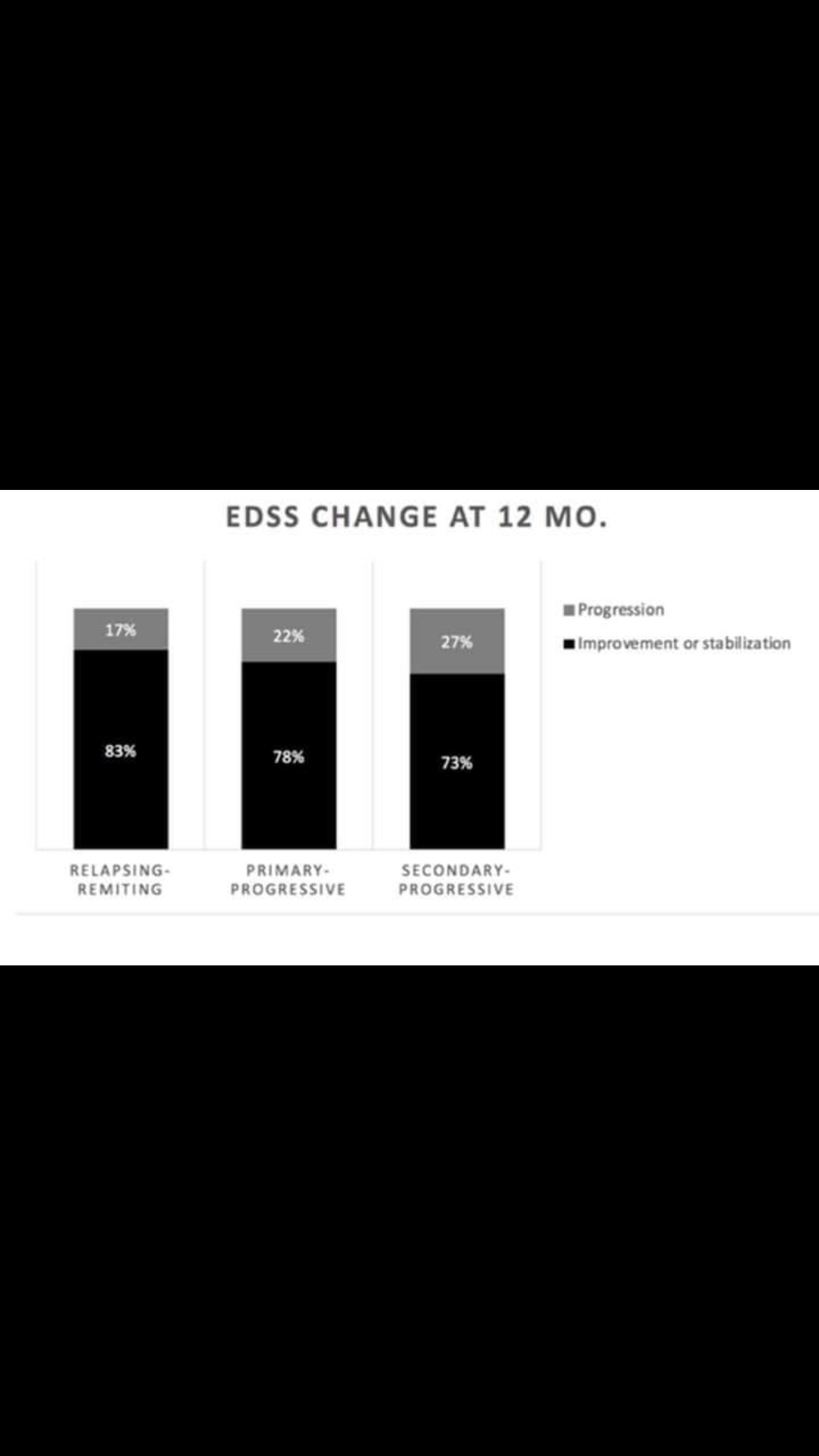
HSCT also does not promise to improve your MS symptoms, but so many people experience some improvements in their EDSS. Imagine MS attacking your central nervous system, like a car driving over a road. Over the years, the road can develop potholes, which in MS is permanent damage to the nerves’ protective sheath, called myelin. If HSCT halts your MS, then HSCT removes the car that created the potholes, but it does not fix the potholes. That type of medicine is in the works.
As you can imagine, the sooner after an MS diagnosis that you can get HSCT, the higher your chances of stopping its progression before it even becomes a problem. However, today in the US, you can only qualify for HSCT if you have “failed” three prior MS drugs — if those drugs have failed to halt your MS, which none of them even promise to do. The drugs only “slow the progression.” This requirement to fail three MS drugs is a BS qualification, since these drugs have zero relationship to HSCT, nor to HSCT’s chances of success.
There is a lot of discussion about “flipping the triangle,” which means making HSCT the first action after an MS diagnosis, rather than a last-ditch effort. According to Gavin Giovannoni, PhD, professor of neurology at Barts and the London School of Medicine and Dentistry:
Currently, MS patients are allowed to accumulate a number of disabilities before they can have the most effective treatments, and that is not right…We should be treating MS like stroke, where time is of the essence. And we should be offering newly diagnosed patients the most effective treatments such as monoclonal antibody-based therapies and aHSCT first to prevent too much organ damage.
Chapter 6 of 6: An Unexpected Pathway Leading To Gratitude
Prior to HSCT, many of us alumni preferred to minimize drugs in our lives to the greatest extent possible. Hell, my entire blog site is based on the peer-reviewed, published research that led to my decision in 2014 to stop taking MS drugs. The idea of a natural approach had always been really appealing to many of us. So HSCT – chemo and plenty of other drugs during and for six months after the procedure – was a really unexpected pathway. And, yet, here we are.
Whether or not HSCT works for me, I will continue following the Overcoming MS lifestyle because, as explained in Everyday Miracles, HSCT does not eliminate your entire immune system. Though nobody says that the OMS lifestyle promotes success after HSCT, it is based on more than three decades of research published by Dr. Roy Swank, and it keeps inflammation low. Many HSCT alumni swear by the paleo diet, and I have no desire to convince them to do otherwise. I myself do not want anything to ever spark whatever of MS might remain in me. I enjoy the OMS lifestyle, even if it is not effortless in a context of the Standard American Diet (SAD).
HSCT makes me grateful: (1) for or the opportunity to have gotten HSCT; (2) to Dr. Burt for pioneering HSCT for MS, writing Everyday Miracles for the layman reader and a medical textbook for other doctors who may be interested in performing HSCT for MS, and for speaking to as many MS podcasts as possible to raise awareness; (3) to Dr. Ruiz, lead of the world-class Clinica Ruiz in Mexico, for delivering HSCT for a relatively affordable cost in the most humane and “enjoyable” manner possible and for taking time to personally meet each patient four times during my month-long procedure; and last but definitely not least (4) to all my fellow HSCT warriors globally for their friendship and courage throughout the procedure and the long, loooong rollercoaster.
Footnote:
- Facebook HSCT groups: Find the global group by searching for HSCT Hematopoietic Stem Cell Transplant – MS & Autoimmune Diseases, and for Mexico groups, search for Mexico HSCT for MS & Autoimmune diseases.
 Blessed with MS
beautifully done, sarah. very engaging. as on past occasions i am proudly impressed with your clear, clean, solid writing.
i hope it reaches a lot of the right kinds of people!
LikeLike
Sarah – you are such a compelling writer and an inspiration to boot!! You have a cheering section here in Takoma Park as you embark on your roller coaster recovery ride 🙂
LikeLike
Hi, Sarah! I just read your email. You have been on one heck of a journey. I’m so glad you were able to get HSCT and that all of your years of dedicated working have added up to the ability to rest-to-heal now and reduce stress. Where are you and Ricardo living now? Let’s find a time in the next week for a call — does that work?
Love! Wendy
LikeLike